My Library Card Opens More Than Any Work Pass Ever Did
A small piece of plastic and the freedom to be interested in something useless.
The message said my reservation was ready. It was a book about salt.
Once, a message like that meant a hotel, a hire car or a flight I would spend the next few hours hoping remained on schedule. Now it meant I could walk to the library and collect something I wanted to read for no professional reason whatsoever.
I put my coat on promptly. Salt, it turns out, can generate more enthusiasm than an airport lounge.
There was no connection to make, no person expecting me to arrive with a useful answer and no reason to establish whether the book would improve a decision I was being paid to make. I could simply be interested. The message had given that interest a practical destination, and the destination was a pleasant walk away.
I like a modest piece of anticipation. Something waiting which I actually want. Not an obligation wearing the word opportunity, not a notification designed to make me feel late. A book had arrived because I asked for it. I could collect it and see what the asking led to.
My wallet contains a few cards that promise rewards and one that promises books. The rewards usually involve buying more of something first. The books do not require me to demonstrate brand loyalty to a tub of spread.
This strikes me as an excellent arrangement.
The small piece of plastic has none of the importance my old work passes appeared to possess. No title attached, no suggestion that presenting it establishes a particular professional standing. It identifies an ordinary reader. That is all it needs to do.
Yet the ordinary reader can reach into subjects far beyond the ordinary week. A history, a place, a way of thinking. Something he did not know he would find interesting until the cover caught him. The access is modest in its appearance and large in the possibilities it allows.
My work pass admitted me to a defined purpose. The library card makes room for purposes I have not defined yet. The title of this piece is deliberately partial in that respect. The work pass opened doors which mattered, some of them associated with responsibilities I valued. I am not pretending those doors were worthless because I have since acquired a book about salt.
But this card has a kind of openness the other one did not. I can enter without being required to perform a role. I can ask for something without already knowing what use I will make of it. I can be new to a subject and remain entirely qualified to look.
The qualification is curiosity. I find that wonderfully economical.
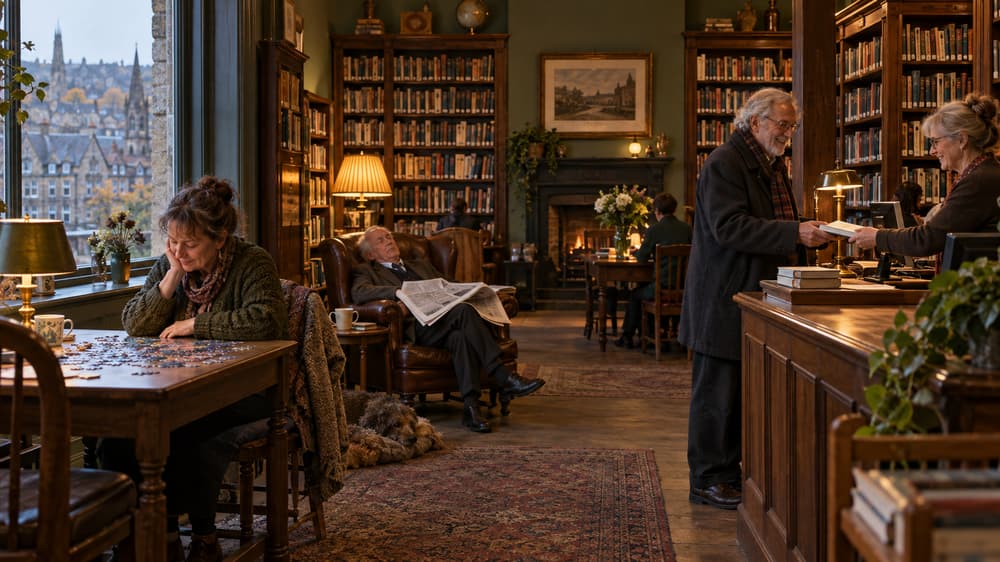
The library is modest. Patched, familiar, warm. There are people who seem to have established unofficial positions within it: the jigsaw person, the local-history person, the person with a laptop and an expression suggesting either literary genius or a difficult password.
There is also a man asleep over the newspapers. He has been there so consistently that I am beginning to wonder whether he is available on loan.
I like that nobody hurries him. Nobody hurries me either. That is rarer than it should be. So many places require you to keep buying, keep moving or explain what you are doing there. In the library, being interested is sufficient qualification.
Not every visit is serene, naturally. A public place contains other people, and other people continue being themselves even when I would prefer a perfectly quiet atmosphere. There may be movement, a conversation, someone seeking help with a practical matter. The room is not a private reading retreat arranged for my particular temperament.
That is part of its value too. I can be among people without needing to turn every encounter into a social event. We are each there for a reason, and the reasons do not have to match. The book, the newspaper, the question at the desk. Different uses can occupy the same place.
I would be reluctant to infer whole lives from those uses. The laptop expression may indeed concern a password. The man with the newspapers may be tired. The person who knows the shelves may still be looking for something unfamiliar. I can enjoy the small scene without pretending to know everybody's circumstances.
The room offers a little shared space, not a licence to invent the people inside it.
Retirement has made that shared space more available to me. I can visit at a less hurried hour. I can remain long enough to look at a shelf rather than go directly to the thing I intended to collect. I can allow a second interest to appear without immediately calculating how it will fit into the next obligation.
There is pleasure in that room around the errand. The collection is the practical task. The looking is the part I might once have omitted because it seemed unnecessary. Now unnecessary can be an attractive quality rather than a reason to move on.
A thing need not be necessary to be worth some attention. I have spent years knowing that in theory and too many hours behaving as if the theory applied only after all obligations had been satisfied.
Obligations can continue finding one another indefinitely. Retirement has not removed bills, maintenance or the ordinary work of keeping a day functioning. But it has given some pleasures more room before the late afternoon, and I would like to stop asking them to wait for a complete absence of practical demands.
The book about salt had waited long enough for the message to arrive. It did not need to wait until I had finished being a responsible adult.
For a long working life I read what I needed. Reports, regulations, the practical instructions attached to things that could go wrong. Curiosity had to fit around relevance.
Some of that reading was interesting. I don't want to make the earlier life sound like a continuous assault by dull paper. Understanding something properly could be satisfying. A detail could matter. A clear explanation could make a difficult task easier.
But the purpose often arrived before the interest. I needed to know, therefore I read. If the subject did not hold me naturally, the responsibility provided a reason to continue. That was an appropriate arrangement for the work. It is not the only arrangement reading can have.
Now relevance can wait outside.
I can borrow a book because I want to know how maps developed. Or how bees organise themselves. Or because the cover has persuaded me that a subject I have never considered might be worth an afternoon.
If I don't like it, I can bring it back. No committee needs a report explaining the failed experiment.
I am especially fond of that permission. A borrowed interest is not required to become a successful purchase. I can try, discover that the book is not for me and return it without defending the choice to anyone beyond whatever small committee I have installed internally.
The internal committee can still be troublesome. You chose this. You ought to finish. Perhaps you would enjoy it if you concentrated properly. These are not always useless thoughts. Sometimes a book takes time to open. Sometimes attention rewards patience. But the committee can also confuse perseverance with respect for a decision which no longer serves the reader.
I can decide that I do not want more of the book. The decision is allowed to be local. It does not establish that I am intellectually lazy, incurious or incapable of understanding the subject. It establishes that this particular book, at this particular moment, is not giving me what I want from the reading.
Another book may. Another month may. The experiment has provided some information even when the result is a return rather than a completion.
There is a quiet wealth in that. Not unlimited choice, exactly, but the ability to try without turning every interest into a purchase. A shelf becomes a series of doors you can open, see what is inside and close again without embarrassment.
The closing matters as much as the opening. If every door had to become a permanent commitment, I would be less willing to look. A modest cost in time can be acceptable when the inquiry is genuinely interesting. A financial purchase adds another consideration, and sometimes another reason to continue merely because I have paid.
Borrowing does not make time free of value. An afternoon still belongs somewhere. But it can make the choice less burdened by the feeling that I must obtain the full worth of an object before I am allowed to admit it wasn't what I hoped.
I would rather let curiosity remain curious than require it to become an investment thesis.
The library also permits a kind of ignorance I enjoy. I can know almost nothing about a subject and be drawn towards it without needing to establish a respectable starting position. There is no requirement to introduce my earlier expertise before asking where something might be found.
At work, knowledge had a visible role. People expected an answer in the area for which I was responsible. I learned to respect what I knew and what I needed to find out. But I also became accustomed to arriving as someone with useful experience already attached.
Here I can arrive as someone who wants to know about salt. That is a perfectly adequate introduction. I do not need to explain how a maritime background might make the interest less surprising. The interest is permitted to exist without a professional genealogy.
There is relief in that. I can be a beginner in a subject at an age when beginning sometimes feels more awkward than it ought. The shelves do not ask why I haven't understood this already. The book begins where it begins, and I can join it without a statement about my history.
I don't have to become the leading retired authority on anything by the time I return the book. I can enjoy a subject and remain partially informed. I can learn a detail, forget another and still have had a worthwhile encounter.
Learning for pleasure does not require the same result as preparing for a decision. The result can be interest itself, a question I had not thought to ask or a different way of noticing something ordinary.
A book about an ordinary substance is an appealing example. I encounter salt without generally wondering about it. The book offers a reason to wonder. I am not going to reproduce its facts here without a proper account of the particular source. The pleasure I want to describe is the shift in attention: something familiar becomes less fully known than I had assumed.
The world gets a little larger without my travelling anywhere dramatic.
That is a particularly useful pleasure in later life. There are still places I might want to go, but curiosity need not wait for a trip, a budget or the energy required to organise an impressive outing. It can begin with a subject small enough to sit on the table and broad enough to occupy the mind.
I don't mean books replace actual places. They don't. An account and an experience are different things. But the account can be valuable on its own terms, making a place more vivid, a question more interesting or an afternoon more inhabited.
I would like not to call that second best simply because a brochure would have preferred a photograph of me beside a distant landmark.
The library is local. That is part of its usefulness, not a limitation it should apologise for. I can go there within an ordinary day, bring something home and begin. The interest does not require becoming an expedition before it receives attention.
I have spent enough of life travelling for reasons supplied by work. There is a lovely change in moving a modest distance towards something I want, with no professional argument required for either the journey or the subject waiting at the end.
I put my coat on promptly for salt. That sentence still makes me smile. Enthusiasm does not always have good publicity, but it can be genuine at a very ordinary scale.
I find myself wanting to defend the place without making it sound like a worthy duty. I don't go because I am noble. I go because I enjoy it. That enjoyment is probably the strongest case I can honestly make.
A building where people can sit, learn and belong without first paying is worth having. It doesn't need to become fashionable to justify itself.
I know these places aren't guaranteed. Opening hours and budgets are real things, not sentiments that can be wished away. Borrowing a book won't settle every argument about public spending.
Nor can my pleasant visit describe every person's access. Different places have different provision and different practical conditions. A library I can reach comfortably may not be equally easy for someone else to use. I do not want gratitude for my own access to become an assumption that everyone has the same arrangement.
The particular place matters because it is there and usable for me. The broader question deserves attention beyond the feeling I have when leaving with a book. Feeling strongly about an institution is not the same thing as knowing how to sustain it.
Still, using something is different from praising it while walking past. So I reserve, collect and return. I let my curiosity make a small record of why the building matters.
The record is modest. I am not imagining that one borrowing decides the future of the service. I am simply doing the thing I value being able to do rather than leaving the value entirely in a sentence about how important libraries are.
There is a practical honesty in that. The praise corresponds to an actual pleasure. The institution is not an ornament in my account of a civilised society; it is a place I visit for something I want.
I would like that distinction to remain visible. Worthy language can make a place sound like homework assigned to the public. A real pleasure is a more companionable invitation: here is something good, and I have found room for it in an ordinary week.
The invitation need not promise improvement. I do not emerge from every visit wiser, calmer or more impressive. Sometimes I find the thing I wanted and go home. Sometimes I look for a while and find nothing. Sometimes an unexpected subject catches me. The variety is part of the experience.
I can enjoy the visit without demanding it become a transformative event.
There is a difference between a place which lets me stay and a place which continually requires another reason for staying. I notice it more now that some hours belong more fully to me. A seat can be available in many settings, but the expectation around the seat changes the experience.
In a shop, I am usually expected to buy or move on. In some other places, a purchase establishes the first period of permission and another purchase may make a longer stay more comfortable. These are ordinary commercial arrangements. I don't object to a business needing customers. I simply value a different arrangement existing beside them.
The library allows the interest to be the reason. I can look, choose, sit, ask or leave. The building is not offended if no book has become a purchase by the time I put my coat back on. That makes the visit less defensive. I do not have to justify occupying a small part of the room through another transaction.
It is an unusual freedom when so many ordinary activities seem to acquire a payment, a login or a request for permission to send further offers. My library card asks less of my enthusiasm than a loyalty card. I can be interested today without promising to remain commercially interesting tomorrow.
The contrast is not a universal complaint about every business. I use shops and enjoy some of them. I like a good café. I can value a commercial place and still appreciate the existence of a public one with another purpose. The two need not enter a contest before either receives recognition.
What I value here is room for the person without an immediate requirement to convert the presence into spending. The room has practical rules, naturally. A shared place needs them. But the underlying invitation is different enough that I feel it when I come through the door.
I am not there to demonstrate my value as a customer. I am there to use a service intended to be used.
That can be especially welcome after work ends. A working role supplied many reasons to enter places. Meetings, tasks, questions, people expecting me. The role explained my presence before I had to. Retirement can remove those invitations without automatically replacing every one of them.
A place I can choose to enter with a simple interest gives the day a small, voluntary destination. It is not a substitute office. I have no desire to bring the old reporting structure to a shelf of history books. It is a place which allows me to be present for a reason I recognise as mine.
The small reason can be enough. Collect the book. Look at something else. Read a little. I do not need to call the visit research in order to make it respectable. The subject can remain a subject I enjoy rather than one which contributes to a professional ambition.
Even writing can complicate that freedom. I can read something and immediately wonder what I might do with it on the page. A sentence, an idea, a possible article. There is genuine pleasure in that connection, and I am not trying to sever it. But I would like some reading to remain unclaimed by output.
A book can give me an afternoon without being required to give me material. I can be the reader rather than the man already arranging the subject into something he could publish.
That is another role I may need to set aside occasionally, not because the writing is unwelcome but because every interest should not be recruited before it has finished introducing itself.
The salt book can remain a salt book for a while. Its immediate job is to be interesting. That is a more modest demand than improve the business, supply a clever observation and justify the use of the morning.
I have asked books to carry too many things before. Information, authority, completion, the reassuring appearance of a person who reads serious material. Some of those demands belong to particular circumstances. Some are simply habits which have survived the circumstances.
Borrowing for pleasure gives me an opportunity to notice the difference. I can select a book which genuinely draws me rather than one which would look impressive beside a chair. I can stop when the interest has gone. I can continue slowly when the interest remains, without converting the pace into an assessment of my discipline.
The card opens more than shelves in that sense. It opens a different relationship with not knowing.
Not knowing can be inviting rather than embarrassing. A subject I have not considered offers something new. I do not need to hide the gap because a responsibility is attached to already having the answer. I can begin with curiosity and remain curious even when the explanation becomes difficult.
A difficult passage is not a personal accusation. It may require time, another reading or a different book. I can ask about it, leave it for later or decide the current account isn't the one I want. None of these responses establishes that learning is no longer for me.
This matters when age makes beginning feel unnecessarily visible. A person may imagine they should already know more, given the years available. But there are far more subjects than years, and experience has not been distributed evenly across them. I can know a great deal about one kind of work and very little about salt.
The ignorance is local. The curiosity can begin there without an apology.
I don't need to make the library into a shrine to learning to appreciate that permission. A shrine would probably discourage the man asleep over the newspapers, and I am rather fond of his refusal to make the room a performance of improvement. The place contains rest as well as study, familiar routines as well as new interests.
It would be less hospitable if every person had to look visibly enriched throughout the visit. I do not always look enriched when concentrating. I often look as if I have lost an argument with a password, even when the book is behaving perfectly well.
The right to remain ordinary in a useful public place is part of the pleasure.
I can be a reader with a coat, a bag and a question. The visible details need not establish my rank. No old title is required at the counter. The useful card fits in a wallet beside objects which are much more eager to tell me what kind of customer I should become.
The library card has a simpler ambition. Let me borrow, let me return, let me try another subject when something else catches me. I like that restraint.
There are rules around borrowing, and I should respect them. Shared access depends on ordinary consideration. Return the thing, look after it, understand the arrangements which apply in the place I use. Freedom to try is not freedom to treat the resource as exclusively mine.
The sharedness is not an inconvenience added to the pleasure. It is part of what makes the pleasure possible. The object can be used by someone else after I am done. An interest can move from one reader's afternoon into another without requiring each reader to possess the thing permanently.
I enjoy ownership too, in some cases. There are books I want near me, books I return to and books whose familiar presence matters. Borrowing does not have to replace that. It provides another way of encountering subjects, a way which does not require every attraction to become an acquisition.
The distinction can make curiosity more adventurous. I can try something whose appeal is uncertain. If it does not hold me, the return is part of the arrangement, not evidence that the whole choice was foolish. If it does hold me, I have found something without needing the certainty beforehand.
That is a useful kind of experiment in retirement, where a new interest can otherwise acquire the weight of a possible identity. A purchase, equipment, a plan, the expectation that I will remain committed. A book can be an easier beginning. I can find out whether the subject has more to say to me.
The easier beginning need not remain small if the interest grows. It simply means the growth can be discovered rather than promised in advance. The next choice can follow the actual experience.
I prefer that to being told I should reinvent myself with enthusiasm and a suitable amount of equipment. Reinvention sounds as though the current man must be discarded. I would rather expand what he can notice while allowing him to remain recognisably awkward about a few things.
He can still be delighted by a reservation. He can still misplace the card briefly while it is in the pocket where he deliberately put it. He can still take home a book about something ordinary and find himself less certain he has fully understood the ordinary thing.
That last uncertainty is enjoyable. It is not the uncertainty of a practical decision waiting too long. It is the discovery that the world contains more detail than the familiar label suggested. A common subject has acquired depth, and I am allowed to spend some time in it.
The depth can remain useless in the narrow sense. I may have no practical application for the information. Nobody is waiting for it. A bill will not become smaller because I read the chapter. The supermarket will continue selling the thing regardless of how much I now wonder about it.
But usefulness is not the only form of value. The reading changes the experience of the afternoon. It gives curiosity something substantial to inhabit. It may make me notice differently, ask another question or simply enjoy the fact that I am not required to know the answer before beginning.
Those effects belong to the life the practical arrangements are intended to support. I would like not to dismiss them because they cannot be entered against a household expense.
Money still matters. Time still matters. A pleasant library visit does not settle every concern about retirement. I do not want to turn modest pleasures into instructions for people facing harder circumstances, as if an interesting book could replace the support they need.
The claim is smaller: where this opportunity is available, I value using it. It gives my own day something I enjoy. That is sufficient reason to describe it honestly and to notice what would be missing if it were no longer there.
The missing thing would not be only access to one book. It would be the particular arrangement of place, permission and curiosity. The ability to enter a room with an uncertain interest and leave with something to try. The absence of a requirement to be impressive, profitable or already informed.
I would miss that considerably more than the small piece of plastic suggests.
The old work pass belonged to a necessary role. I carried it because the role required access. The library card belongs to a choice. I use it because the opening interests me. Both can matter in a life, and the change between them does not require one to be declared superior in every respect.
But in the life I am living now, I find the chosen opening particularly welcome. It is a modest sign that there are doors I can approach because I want to, not because someone has assigned the destination.
There is another pleasure in borrowing which I hadn't named clearly until I had more time. The object has a temporary place in my life. I can bring it home, give it attention and let it leave again. Not every good encounter needs to remain permanently on a shelf as proof that it happened.
I have enough objects carrying proof already. Papers from earlier work, things kept because they once had a purpose, books bought with intentions which are still somewhere between the intention and the reading. I am not declaring a campaign against possessions. Some are loved, some useful, some simply pleasant to have. But the ability to encounter a subject without adding another object indefinitely is welcome.
The return can be a completion which does not require mastery. I have spent time with the book. I may have finished it or reached the point where I want to stop. It can go back into the shared arrangement. The interest has existed whether or not I retain a physical reminder of it.
I can retain a thought instead. Or a question. Or only the impression of an enjoyable afternoon. Memory will not preserve every detail, and the forgetting does not retroactively make the pleasure false.
I don't measure a walk by how accurately I can reconstruct every turn afterwards. I can grant reading something of the same generosity. I was there, in the subject, for a while. That counts in the ordinary sense of mattering, not necessarily in the sense of a record I should improve.
A record can still be useful. I can note an author, remember a title or look for something related later. The point is not to refuse every practical support for curiosity. It is to let the support remain subordinate to the curiosity rather than become an extra obligation attached to enjoying something.
The library supports that relationship quietly. Its existence means I can return and try again. The next subject need not be related to the last. I can follow a thread, change direction or select something because it looks unexpectedly inviting. The freedom includes the right not to produce a coherent programme of intellectual development.
There may be a pattern over time. There may not. I can notice the pattern without deciding in advance that every choice must contribute to it. A person is allowed several interests and a few entirely disproportionate enthusiasms about common substances.
Salt has become one of mine for the moment. I do not know how long the enthusiasm will remain vivid. I needn't make a promise about that before enjoying the current chapter.
The message was ready, the coat was put on, the book was collected. An ordinary sequence with an uncommon amount of pleasure in it. I would once have rushed the same kind of errand and treated the looking as delay. Now the looking can be part of what I chose to go out for.
That is a change worth having. It asks for no grand announcement about becoming a different man. The same man has a little more room to be interested, and a place nearby which makes the interest easier to follow.
I am grateful for both. Gratitude need not mean every visit becomes solemn. I can smile at the familiar figures, fumble for the card, wonder what the laptop expression concerns and go home with an unlikely subject under my arm. The pleasure can remain companionable and ordinary while the arrangement which permits it remains something I value rather deeply, in ways a little piece of plastic has no need to explain for me.
For now, it is enough to open the book and see where the next page takes my attention.
The book about salt is excellent. I can't yet tell you what practical use I will make of it.
That is, for once, not a criticism.
Before you wander back into the ordinary noise of the day, do one small thing with this.
Not a grand reinvention. Not a ten-year vision board. Just a quiet refusal to drift.
Because later life has a habit of becoming whatever is left after everyone else has had their say: the pension provider, the calendar, the family WhatsApp, the old job still living rent-free in your head.
The danger is not that you fail to make a plan.
The danger is that you inherit one by default.
If this piece nudged something uncomfortable but useful, I’d start here:
The Second Act Playbook is for building the shape of the next chapter before life fills it in for you.
The Retirement Identity Check-In is for the quieter question underneath it all: who are you becoming when the old labels loosen?
One is Free the other isn’t I will leave it to you to have a look. Neither is about panic.
They are about not waking up five years from now with a tidy pension and a life that somehow forgot to include you.
This article is also live on X: https://x.com/greythinkeruk/status/2113515401644494860