Nobody Warned Me About Becoming the Oldest Person in the Room
Kindness can feel surprisingly like a change in status.
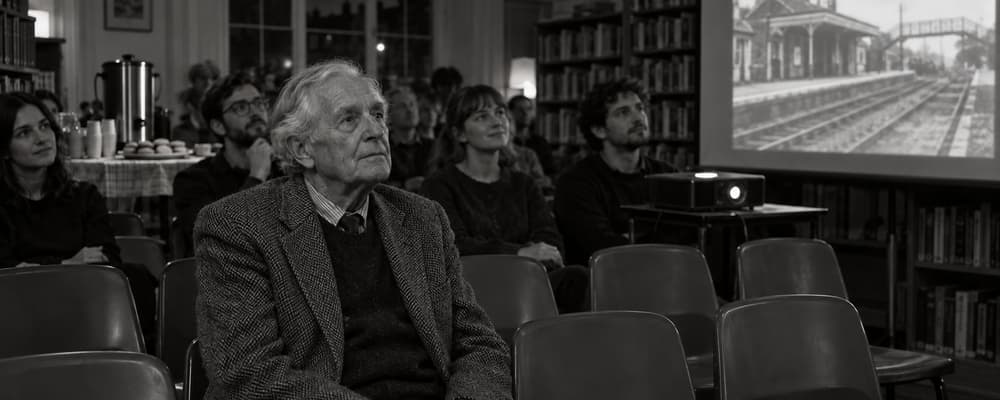
A young man offered me his chair at a library talk. There were several empty chairs nearby.
I had managed the stairs. I had managed the door. I was reasonably confident I could manage the final few yards to some available furniture. Nevertheless, he stood beside his seat with the expression of someone who had been presented with an opportunity to do the right thing.
I thanked him and sat down. Refusing would have required a speech, and we were already attending one.
The chair was perfectly comfortable. I cannot fault the chair. It had performed no assessment, made no assumption and offered no opinion about the man now occupying it. My difficulty concerned the circumstances under which it had become mine.
I looked at the empty chairs and then at the young man, who had found another seat without apparent inconvenience. He seemed satisfied. A courtesy offered, a courtesy accepted. His part in the exchange appeared to have concluded. Mine had opened an investigation.
Looking around, I realised I was the oldest person there. Not dramatically ancient. Just noticeably ahead of the rest of the room in the calendar.
It had happened without consultation.
I had come to hear something interesting. I had not come to occupy an age category so visibly that another person would stand up in its honour. The difference between the visit I intended and the status I appeared to possess was small enough to sound ungrateful and large enough to interrupt the first few minutes.
For years, I had been the young one being told to watch and learn. Then I occupied the comfortable middle, where nobody sent me for things and nobody asked me to recall the early days of civilisation. Now I had apparently been promoted to historical evidence.
The talk concerned the Victorians. When the speaker looked towards me during a question about an old station, I briefly feared she wanted an eyewitness account.
I could offer a view about the building. I could not offer personal memories of the opening ceremony. The distinction seemed worth maintaining, though nobody had actually challenged it. I had supplied the joke and then felt faintly accused by my own joke, a very efficient arrangement.
There is a strange moment when the room establishes your age more clearly than your own thoughts do. At home, I am simply the person in the room. My interests, irritations and habits arrive without a comparison attached. Elsewhere, the distribution of faces can place me at an edge I had not expected to occupy.
I don't go around estimating everyone's age. Not usually. But I can notice that the people around me are younger in the ordinary way you notice a change in weather. The fact enters before I have decided whether it matters.
Sometimes it doesn't. A shop, a bus, a conversation about something practical. We have reasons to be there which require very little attention to birthdays. Other times the fact seems to acquire a role immediately. Someone offers assistance. Someone assumes a memory. Someone speaks as if I might be less familiar with the present than I actually am.
I knew age would change how I felt. I hadn't quite appreciated how it would change the assumptions made by perfectly pleasant strangers.
There was no hostility in the room. Quite the opposite. People were considerate. Careful. They made space and offered assistance. I have no wish to live in a world where they do neither.
That is what makes the response awkward. I am not objecting to a clear insult. I am responding to a decent gesture which may or may not contain an interpretation of me. The gesture deserves gratitude. The interpretation, if there is one, is the part I want to inspect.
Were they seeing a person, or a category? Was the chair a courtesy, or an assessment? Why was I turning a kind gesture into an investigation?
The answer is probably pride, but probably isn't an entirely comfortable answer.
Pride likes a more respectable description. Independence, perhaps. The wish to remain accurately seen. A reasonable objection to assumptions made without inquiry. There is truth in those descriptions. There is also a man who would prefer strangers to recognise the version of him he finds most reassuring.
That version is capable, experienced and entirely able to locate a chair. The actual version is capable of those things and also capable of becoming unnecessarily unsettled when someone is polite about them.
I would like to be fair to both men. I would also like to be fair to the young man, who had performed a courtesy and was now listening to the talk rather than analysing the implications of his own seat allocation.
He may offer a chair to anybody standing near him. He may have thought I would prefer that particular seat. He may have noticed my age and chosen to be considerate. None of those possibilities establishes that he thought I was incapable.
I had moved quickly from assistance to judgment. That move belonged to me, not necessarily to him.
The actual evidence was modest. He stood, offered, found another place. I accepted. There were empty chairs. There was no further comment. Any account beyond that contained interpretation, and mine had selected an interpretation with rather more discomfort than the evidence required.
It is worth noticing when a familiar worry starts writing the missing part of a scene.
I worry, sometimes, about becoming a category before I become a person. Older man. Be patient. Make room. Possibly speak more slowly. A whole sequence of possible responses can gather around an appearance without anybody asking what I have come to do.
The worry is not entirely invented. People do make assumptions from age, just as they make assumptions from clothes, accents and the other visible pieces of a stranger. Some assumptions are convenient. Some are inaccurate. Some are kindly meant and still reduce the room available for the actual person.
But anticipating the reduction can create its own narrowing. I spend the evening monitoring how I am seen and stop attending to what I wanted to see. The category takes over partly because I have given it so much attention myself.
That is an uncomfortable possibility. I can be defending against a change in status so vigorously that I miss the pleasure of being there at all.
The pleasure was genuine. A library talk. A subject I wanted to know more about. A warm room and an evening which did not have to justify itself professionally. Retirement had made room for the visit, and curiosity had brought me through the door.
I would rather those facts received more of the evening than the chair.
The speaker began explaining something about the buildings. I tried to listen properly. A detail caught me. The age calculation receded for a moment because there was something in front of me which required interest rather than self-consciousness.
Then I noticed the receding and became self-conscious about it again. The mind can turn even relief into something to monitor if given sufficient encouragement.
I let the explanation continue. The room had not assembled to decide whether I was ageing appropriately. It had assembled for a talk. That seemed a sensible fact to return to whenever my own private event threatened to dominate the public one.
For most of my working life, age had a different social meaning. At first there were people older and more experienced, people from whom I needed to learn. Their presence could be reassuring even when their impatience wasn't. Later I became one of the people whose experience was expected to supply a response.
The movement between those positions was gradual enough that I did not always notice it. A question directed towards me. A younger face waiting. The realisation that I was no longer the person most likely to be sent to fetch something.
That change had responsibilities attached, but it also offered a kind of comfort. There was a place I understood. Experience had relevance. The face people looked towards was connected to something I could actually help them decide.
In the library room, the face had acquired another possible relevance. Experience I might not possess. Frailty I might not feel. The assumptions could move in opposite directions while being equally inaccurate.
Neither left much space for simply being curious about local history.
I did not need to be the expert witness or the person who required a cushion. I could be a participant. A man who knew some things and wanted to learn others. That is an ordinary place, and one I would like to remain able to occupy without explaining my entitlement to it.
Perhaps the room had already given me that place. Perhaps I was the person interrupting it with concerns about the seat.
On ships, competence mattered more than appearances, though appearances still influenced whose face people looked towards when something happened. A familiar authority could reassure people. A person looking young might need time for their competence to become visible. None of this made appearances reliable, but they affected the beginning of an exchange.
I had benefited from that at times. Experience became attached to the face people expected. I cannot pretend I have always insisted on being judged from scratch without the help of any visible clue.
That makes the new discomfort more complicated. I am not opposed to every assumption. I am opposed to the assumptions which no longer match the place I wish to occupy. There is a little vanity in that, alongside the reasonable wish for accuracy.
I can admit the vanity without deciding the whole concern is foolish.
Being seen accurately matters. A person can be older and quick, older and tired, older and knowledgeable about one subject while new to another. The age may be relevant to a particular need without explaining every capacity. Courtesy is most useful when it leaves space for the person's response.
The young man had left space. He offered. I could have declined. He did not insist, lecture or make a remark. The gesture was more flexible than the interpretation I had placed around it.
I had accepted partly because it seemed kinder and simpler than refusing. That was my choice. I should not convert my own choice into evidence that somebody else had denied me one.
There is relief in following the scene carefully enough to see that distinction.
The chair itself began to look less like a status change and more like furniture made available by a decent person. The explanation was not grand, but it fitted the evidence. I am trying to become more willing to accept explanations which fit without demanding that they reassure me in every conceivable way.
A courtesy can be a courtesy. It need not contain a complete declaration about how the giver regards my future.
I also need to allow that I may occasionally want the assistance. There are days when a seat is welcome, a door held open is useful and a small consideration makes the next part of an outing easier. Accepting those things does not make independence disappear.
Independence has never meant doing everything alone. My ability to attend the talk depended on people arranging it, opening the building, providing information and doing many practical things I did not witness. The offered chair was only the most visible assistance in a situation already supported by others.
I had noticed it because it touched a sensitivity, not because it uniquely compromised my self-sufficiency.
A narrower account of independence might be more usable: having a say, making choices, being treated as a person whose response matters. Under that account, an offer of help can coexist with independence. The crucial question is not whether help exists, but whether the person receiving it is allowed to participate in the decision.
That seems sensible. I would like it to become something I feel as well as something I can write.
There are times when assistance is delivered as an assumption rather than an offer. Those can be awkward. A task taken over without asking. An explanation slowed down unnecessarily. A person spoken around rather than spoken to. I have no wish to pretend that kind intention always produces respectful treatment.
I can dislike such an encounter without becoming suspicious of every kindness. The ability to distinguish the two is part of the work now. Not work in the old sense, but the ordinary effort of meeting changes in how I am seen without allowing them to make every room a difficult one.
If I expect insult everywhere, I make welcome harder to hear. If I deny every problem, I stop trusting my own judgment. Somewhere between those responses there is room for the actual encounter.
The library encounter deserved that room. It had been kinder than the worry I brought to it.
Then I asked a question. An ordinary question about the buildings. The speaker gave it proper attention. The room listened. For a moment the age business receded and there was just a conversation about something I wanted to understand.
That is what I had come for.
The question did not require a preliminary statement about my background. I did not need to announce that I had held responsibilities elsewhere before asking for a detail here. The interest itself was enough to justify speaking.
That felt good in a quiet way. I could be new to something. I could want information rather than possess it. The response addressed the question, not the category in which I feared the room had placed me.
Nothing dramatic happened. Nobody revised their estimate of my capability in a visible ceremony. The conversation simply worked. Perhaps that was the better form of reassurance: being involved in something ordinary without needing reassurance to be the subject.
A person can remain a person through participation. Ask, listen, notice, reply. The exchange supplies more detail than the appearance with which it began. It does not abolish age, but it can prevent age from doing all the explaining.
I would like more of those exchanges. Not because I need to prove I can still ask a sensible question, but because the question is interesting and the answer changes what I know.
Proving would make the task heavier. I could sit there trying to devise an impressive contribution and miss the actual point which caught my attention. An ordinary question offered out of curiosity is a more comfortable way into the room than a performance designed to overturn an imagined assessment.
I do not need to win back status during a talk about buildings. I can simply learn something about buildings.
The oldest person in the room is still permitted to be the person who knows least about the subject. Age does not require me to supply historical authority whenever the past is discussed. I may have experience from another setting and no particular knowledge of this one.
That is not a failure of age to deliver its promised wisdom. It is ordinary variation in what people know. Younger people can have substantial expertise. I can listen to it without interpreting the direction of learning as a reversal of dignity.
I have enjoyed learning from people younger than me before. I should not forget that merely because the room makes the comparison visible. The information has a source. Its value is not determined by the birthdays involved in the exchange.
There is freedom in not being expected to know, provided I allow myself to accept it. A working role could make uncertainty feel professionally inconvenient. Here it could be the beginning of interest. I don't have to conceal the question until I have an answer respectable enough to resemble knowledge.
I can ask because I want to know. That is one of retirement's small luxuries.
The pleasure of this stage of life is that I can go to a talk because it interests me. No professional reason. No requirement to turn the information into a useful report. Just an evening, a warm room and something I hadn't known.
I don't want to lose that by spending the whole occasion monitoring whether someone thinks I require a cushion.
The monitoring is tiring. It divides the experience into two events: the talk itself and the private assessment of my place in it. The second can consume attention without adding anything useful to the first. I leave knowing less about the subject and more about the persistence of my own sensitivity.
Sensitivity has already received sufficient research time. The buildings might appreciate a turn.
I am not expecting to become entirely unselfconscious. Rooms contain comparisons, and people notice them. I will probably continue registering when I am older than those around me. The aim is not to become unaware. It is to let the fact remain a fact rather than immediately become the organising principle of the evening.
A date difference can be relevant without becoming a plot. I can be the oldest and still enjoy the same explanation, laugh at the same remark or ask about a detail someone else also wants clarified.
The shared interest offers another arrangement for the room. Not young and old, simply people who have come to hear something. Those categories need not erase the other differences, but they can supply a useful common purpose.
I have missed some of those common purposes since work ended. Work provided them repeatedly. People gathered because something needed doing. Retirement can require more deliberate choices about where to find shared attention which is not merely accidental proximity.
A library talk offers one. Not a solution to every social question, not instant companionship, simply a room in which interest supplies a reason to be together. That reason is enough for an evening.
I do not need every person there to become a friend before the contact can matter. The small exchange has a value of its own. A smile, a question heard, an answer directed towards the person who asked it. These can make an outing feel inhabited rather than merely attended.
The chair offer was part of that contact too. I had tried to separate it from the welcome because it touched an awkwardness. But it may have been the simplest expression of welcome available to the young man at the time.
If so, I would like to receive it more generously. Not by inventing noble motives, just by allowing the reasonable possibility that the gesture meant what a gesture of that kind often means: here is something you might prefer, and I don't mind making it available.
It had not required a label from him. I had provided the label myself.
There is a recurring difference between being treated as older and feeling replaced by the word older. The first may involve relevant consideration. The second feels as if the rest of the person has been taken away. I am more comfortable with the first when I can trust that my response will still be heard.
The room heard the question. That was useful evidence. The young man accepted my thanks and moved on. More useful evidence. Nothing in the evening established that I had been reduced to a category, though my worry had been prepared to make the case.
I should allow evidence to alter the case. Otherwise the investigation is simply a ritual for confirming the verdict I brought with me.
There will be rooms in which the evidence is less pleasant. I may be patronised, overlooked or asked something based on a broad assumption. Age can change the way strangers approach a person, and not all changes are welcome. I do not need to deny that to describe this room accurately.
But a poor experience elsewhere should not automatically be permitted to write the meaning of an ordinary courtesy here. The young man deserves his own encounter, not responsibility for every earlier irritation I carry.
That is a form of fairness I can practise without waiting to become serene.
I can also be fair to the part of me which feels unsettled. It is reacting to change. The visible position I occupy in a room has shifted, and the inner picture has not always shifted at the same pace. A discrepancy can feel uncomfortable even when no person has acted badly.
I don't have to scold myself for the discomfort. I can recognise it, look at the scene and decide whether it needs more attention than the talk. Often it doesn't. The feeling can remain without taking the whole evening hostage.
There is a gentle absurdity in being surprised by a position which time has been preparing for decades. I knew I was getting older. I simply expected the fact to remain more private than it sometimes does. The room was not obliged to preserve my preferred level of discreetness.
No consultation had occurred because the calendar does not usually consult. It makes its adjustments while I am occupied with other things. One day the comparison is visible, and I find myself sitting in a chair which seems to have arrived with an interpretation.
The chair has none, of course. I keep returning to that because it restores the scale. A seat. A decent offer. An evening. The whole question of ageing need not be decided before I can rest my back against furniture.
Perhaps I am carrying too much symbolic weight into practical acts. Help with a door becomes a question about independence. A careful tone becomes a question about status. A chair becomes evidence of a change in the public account of me.
Symbols can reveal real feelings. They can also burden an act beyond what the act can reasonably bear. The young man did not undertake to explain my place in later life. He offered somewhere to sit.
I would like to keep the feeling and reduce the burden. I am older than most people here. That is new enough to notice. It is not sufficient reason to mistrust the entire welcome.
The talk continued. I learned something. I had come out on an evening which could have been spent at home, and the decision seemed worthwhile. Those are ordinary conclusions, but they belong to the actual outing.
I could go home with them rather than a lengthy report about how successfully I had negotiated age-related furniture.
There is also pleasure in being among people who are interested in the same thing without needing to look like them. Shared interest does not require a uniform. Different ages, histories and reasons for attending can occupy the room together.
I may hear a detail differently because of something I have seen elsewhere. Someone younger may ask a question I wouldn't have thought of. The variety can help the subject become larger, provided nobody insists each person speak only as a representative of their age.
I have no wish to supply the older view on every matter. Sometimes my view is simply mine, a product of particular experience and temperament. Another man my age could disagree entirely and would have every right to do so.
The category does not create consensus. It does not assign me a duty to explain all people born near me. I can decline the representative role without declining participation.
That seems another useful freedom. I can be in the room as a person with a question, not as a visiting delegation from an earlier decade.
The same courtesy belongs to the younger people. I should not see an age and supply a complete account of attention spans, expectations or manners. The young man had manners good enough to offer the chair. I had imagination vigorous enough to complicate the offer. The scene does not support a general complaint about youth.
It supports a more local observation about the awkwardness of receiving consideration when consideration reminds me of a change I have not entirely made peace with.
That observation is less dramatic and probably more useful. It gives me a part of the encounter I can adjust. I cannot control every assumption a stranger makes. I can sometimes control whether I continue supplying assumptions after the stranger has moved on.
The adjustment may be small. Hear the words. Accept the offer or decline it. Say thank you when thanks are deserved. Return to the subject I came for. There is no need for the whole interaction to become an examination of decline.
The young man had already demonstrated how to move on. I could perhaps learn that from him too.
I am amused by the prospect. An older man at a history talk learning an ordinary social skill from the person whose courtesy had made him feel unnecessarily old. There is enough irony there to make the lesson bearable.
I don't expect every lesson to require irony, but mine often arrive more comfortably with it. A joke creates room around the awkwardness without pretending the awkwardness is unreal. I can laugh about historical evidence and still admit that being visibly older feels different from simply knowing my age.
The room had made the difference visible. It had also offered interest, warmth and a question answered properly. I would like the account of the evening to include all of that, not only the first unsettling moment.
If I describe it solely as an encounter with age, I erase the thing I enjoyed. That would be an odd way of resisting reduction: reducing the evening myself to the category I didn't want to dominate it.
I can make the account wider. I went to a talk. Someone was kind. I became a little self-conscious. The subject was interesting. I asked something and learned something. Then I went home. An ordinary sequence, with room for more than one feeling.
It does not require a transformation. I have not solved my relationship with ageing through one chair. I would be suspicious of any person who claimed to have done so. Furniture is useful, but it has limits as a psychological adviser.
What changed was the interpretation of one gesture. A small correction, based on the actual scene. Those corrections may be how some adjustment happens, not through a grand acceptance of everything time might do, but through allowing particular encounters to remain less threatening than the worry predicts.
There is hope in that scale. I need not become an entirely different man before enjoying the next talk. I can remain mildly vain, curious and occasionally unsettled, and still walk through the door.
The freedom to attend is real. I have time for a subject which would once have been difficult to fit around work. I can listen without needing the information to become part of an official decision. I can be interested at a leisurely pace.
I don't want the small humiliations of adjustment to conceal that good fortune. They are part of the day, not the whole of it. There are pleasures here which deserve their own space in the account.
Walking home, I decided the young man had probably just been kind. It was a reasonable explanation. I am trying to become the sort of man who can accept a reasonable explanation without holding a committee meeting about it afterwards.
The committee is accustomed to being consulted. It may object to the reduction in its responsibilities. But there are other things available for attention, including the subject I had actually heard and the route home on an evening I was glad to have used.
I could think about a building without calculating whether the room had mistaken me for part of it. I could remember the answer rather than the chair. I could allow the courtesy to remain a small, pleasant act performed by someone whose whole life I did not know.
Those possibilities made the walk lighter. Nothing about my age had changed. My interpretation had become a little less crowded.
I don't know whether I will be the oldest there again. The answer may depend on who decides to come out that evening. My age is a fact about me; being the oldest is a fact about the gathering. I had treated the second as if it were a permanent title awarded to the first.
That is another distinction worth keeping. A room can change. A person older than me can arrive. The comparison can disappear without any change in my capacity, curiosity or need for a chair. It was never a complete description of those things.
Perhaps I should be less willing to let a relative position become an identity. Oldest, youngest, most experienced, least familiar. Each can affect an encounter. None tells the whole person how to occupy it.
I can be oldest and ask the simplest question. I can be least familiar and notice something useful. I can have experience elsewhere and enjoy not being required to exercise it here. The room is larger when those combinations are permitted.
It was probably larger all along. My own vigilance had narrowed the view for a while. I am pleased that the subject widened it again, offering something outside the question of how I appeared.
Curiosity can do that. It draws attention towards the world rather than continually back towards the account of the man observing it. I would like more of that movement, especially in places I have chosen because something interests me.
The next talk need not become a test of whether I have improved. I can attend, notice the room, accept or decline a courtesy and listen. If I become self-conscious again, the self-consciousness can sit beside me without acquiring the only voice.
There will be a speaker, a subject and enough chairs. That seems a promising arrangement for an evening, provided I remember what I actually came to hear.
There is another talk next month. The Romans.
I may sit at the back. Not because of the stairs. I simply don't want to be asked about the plumbing.
Before you wander back into the ordinary noise of the day, do one small thing with this.
Not a grand reinvention. Not a ten-year vision board. Just a quiet refusal to drift.
Because later life has a habit of becoming whatever is left after everyone else has had their say: the pension provider, the calendar, the family WhatsApp, the old job still living rent-free in your head.
The danger is not that you fail to make a plan.
The danger is that you inherit one by default.
If this piece nudged something uncomfortable but useful, I’d start here:
The Second Act Playbook is for building the shape of the next chapter before life fills it in for you.
The Retirement Identity Check-In is for the quieter question underneath it all: who are you becoming when the old labels loosen?
One is Free the other isn’t I will leave it to you to have a look. Neither is about panic.
They are about not waking up five years from now with a tidy pension and a life that somehow forgot to include you.
Also on X: Read this article on X