The Last Day at Work Deserves More Than a Returned Pass
Leaving a role and understanding that you have left it aren't always the same event.
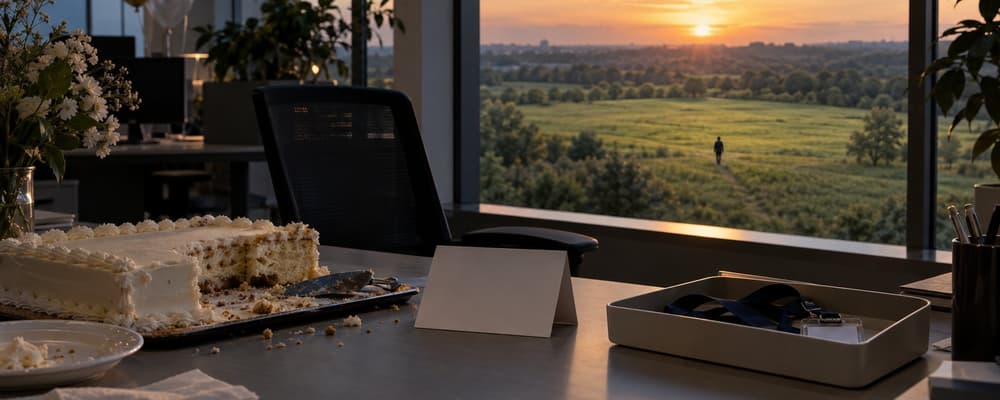
The card says you will be missed. The door says access denied.
That, in a small and rather brutal way, captures the final day at work. A speech, some cake, a few affectionate jokes. Then the pass is handed back and the organisation gets on with being an organisation.
I understand why. The doors have to work for the people who still belong there. You can't keep admitting former employees because their feelings haven't caught up with the database.
But feelings are not databases. They can take considerably longer to update.
A piece of plastic can cease to perform its function in a second. The person who carried it cannot necessarily stop being the person it admitted quite so promptly. The system has a date, a process and someone responsible for completing it. The man has habits, memories and a surprising number of thoughts about things which are no longer his concern.
Nobody seems to be responsible for collecting those. I would probably object if somebody tried. Still, it would be useful to know where they are meant to go.
The card is sincere enough. I don't want to become suspicious of every kind sentence because the access system is efficient. People can mean that they will miss you and still go back to the work once you have gone. Missing does not require the building to suspend its operations. It would be a rather demanding form of affection if it did.
Yet the contrast can sting. One part of the occasion says the presence mattered. Another part establishes, correctly and immediately, that the presence is no longer required. The practical truth and the emotional truth occupy the same doorway, looking in different directions.
A sporting farewell has a shape we recognise. A walk onto the field. Space around the person leaving. The audience understands that this occasion is different from all the other occasions that looked much like it.
The gesture supplies a boundary. Before and after have somewhere visible to meet. The person can acknowledge the audience, the audience can acknowledge the person, and the departure is allowed to be the principal event rather than an administrative detail beside the ordinary work.
I am not suggesting every retirement needs floodlights. I cannot think of anything worse than thousands of people observing my walk to the car. I would become conscious of the way I was holding the bag and probably lose the keys. That is not the dignity I am looking for.
But there is something useful in a recognisable ending. An act which says this mattered, it is finishing, and we are not obliged to pretend it is simply another Friday with a better selection of cake.
Most working endings are less clear. The final meeting becomes final only afterwards. A last voyage feels like a voyage until, months later, you realise there hasn't been another bag to pack.
At the time, there are practical things to attend to. The handover, the travel, the object which needs returning, the arrangement which needs explaining. You do them in the familiar way. Competence keeps the hour moving. The familiar way can make it difficult to notice that this is the last occasion on which it will be required in this particular setting.
Later, an ordinary object reminds you. The bag remains where you put it. A notebook contains a question whose answer no longer concerns your next decision. The old routine waits for a reason to begin and no reason arrives.
That is when the ending can become real, not as a ceremony but as an absence which has stopped being temporary.
At sea, the ship carries on. You leave down the gangway and the next person arrives. There is dignity in that continuity. There is also a small insult in discovering how little the vessel needs to discuss your absence.
It isn't personal. Somehow that doesn't always improve it.
I know why continuity matters. The work must not depend on one person's feelings. Responsibility passes, the arrangements continue, the next person needs room to do the job. A good handover serves something larger than the departing man's wish to remain central.
I have believed that firmly when I was the person staying. It is still true when I am the person leaving. The truth has simply become less flattering from this side of the gangway.
The vessel is not ungrateful. It is a vessel. The operation is not cold because it needs to proceed. It would be absurd to expect the next departure to pause while I establish whether the earlier departures still mean enough to me.
But knowing what is reasonable does not entirely govern what I feel. I can understand the process and still experience the small ache of not being part of it. Reasonableness and loss are not rival explanations. They describe different parts of the same change.
That is one thing I wish the farewell allowed us to say more plainly. You can be glad to leave and still need a moment for what leaving removes. Relief does not invalidate attachment. Attachment does not prove you made the wrong decision.
I do not miss every demand. There are pressures I am delighted no longer to carry. I like waking without immediately establishing how the next obligation will fit around the one already waiting. I like having some of the morning to myself. I like reading without feeling that an unanswered call might be rearranging the day elsewhere.
These freedoms are real. I would not trade them casually for another pass. But the loss is real too, particularly the loss of a place whose expectations made a version of me easy to recognise.
At work, I knew how to arrive. There was something to do and a reason for doing it. Experience had a setting in which it could become useful almost immediately. The role supplied the first sentence of the day before I had to invent one.
Afterwards, the sentence may be mine to write. That is a luxury. It can also be an awkward amount of responsibility to discover beside the kettle.
When work has organised your identity for years, the ending deserves more than administrative tidiness. Not a stadium. Just a moment in which the change is allowed to mean something.
The moment need not explain the whole career. That would be impossible, and probably exhausting for everyone listening. It need not list every accomplishment or smooth every difficult year into a flattering account. A life at work contains dullness, effort, disagreements, luck and tasks whose significance was clear only to the people doing them.
I would prefer an honest acknowledgment of that life to a speech in which every adjective could be used again for the next departing person by changing the name.
A particular memory can say more than a general compliment. Not necessarily a dramatic one. Something which recognises the man rather than merely the length of service. The way he approached a problem, the question he tended to ask, the small habit people will notice when it no longer happens.
These are not instructions to someone planning a farewell. I am not providing a template for improved emotional administration. I am noticing the difference between being thanked in a familiar form and feeling that someone has actually seen what is ending.
The form can be kind. It can also be hurried. People have work. They are awkward with endings. They may be worried about becoming sentimental or making the departing person uncomfortable. A joke supplies a safe route through a moment nobody knows quite how to occupy.
We are remarkably skilled at filling that moment. Small talk. Travel arrangements. Another joke about the years of service. Anything to avoid a silence in which everyone might have to notice that a large piece of a person's life has finished.
I have filled plenty of such silences myself. It is easier to wave and keep moving than to stand still inside an ending.
I can be funny when I am uncomfortable. Sometimes that helps everybody. Sometimes it conceals the thing which might have deserved a more direct sentence. A joke about being free of the place can coexist with an attachment to it, but the joke is usually the easier part to offer aloud.
The serious sentence risks sounding needy. This mattered to me. I am not quite sure what it will feel like when the familiar rhythm stops. I am looking forward to the freedom and I may miss being asked. Those are ordinary truths. They can still feel difficult to introduce while somebody is cutting the cake.
The cake is an innocent participant. It did not apply to carry the emotional burden of a working life. Yet it often receives the job, accompanied by a paper plate and the expectation that the right sort of cheerfulness will conclude the event successfully.
There is nothing wrong with cheerfulness. Some people leave delighted. Some are ready to celebrate and would be irritated by a solemn account of losses they do not especially feel. Endings vary. I would not want every farewell forced into the emotional register I happen to find useful.
The point is room. Enough room for the actual person to leave in the way the change means something to them. Not a compulsory display of sadness, not a compulsory demonstration of relief. A little permission for the event to contain more than one feeling.
The trouble is that an unacknowledged ending can come home with you, unfinished. It settles beside the kettle. You find yourself checking whether an email has arrived or thinking of something you should tell the person now doing the job.
You have left. Some part of you is still in the corridor.
It knows the old route. It expects the old interruption. It can hear a concern and begin preparing an answer before remembering that another person is responsible now. The habit is faster than the fact. That is not evidence that I have failed to retire; it is evidence that the work occupied more than the hours recorded against it.
The door system has no difficulty here. It knows who has access. I am the person holding several contradictory versions of belonging at once. Not employed there, not required there, still knowledgeable about things there, still interested in whether they are going well.
Interest can remain without becoming an entitlement to participate. That distinction takes practice. I can care about something and no longer have a right to decide how it is done. The next person needs the space which the handover was intended to give them.
I am learning this in smaller departures now. Stepping back from a task. Handing something over. Not immediately checking whether it is being done in precisely my way.
That last part remains challenging. I can offer remarkably detailed advice while claiming not to interfere.
The advice is often sincere. I see a possibility, remember a difficulty and want to spare someone trouble. But the wish to help can be mixed with the wish to remain useful in the familiar setting. I should not expect the receiver to untangle my motives before deciding whether the advice is wanted.
I can offer and leave room for refusal. I can answer when asked. I can avoid turning every difference into a problem which requires my presence. The old method is not automatically the right one merely because it reassures the old man.
That is a painful sentence to write and a useful one to keep. A task completed differently may still be completed well. A person taking over may notice possibilities I did not. The operation can continue without becoming a memorial to how I preferred it.
If I want the handover to be genuine, I have to allow the hand to be someone else's.
There is generosity in that. There is also relief. I do not have to keep supervising from an invisible office at home. I can retain experience without volunteering for permanent unpaid oversight. The past does not require my continual attendance to remain a past in which I did useful things.
That should be reassuring. Some mornings it is. Other mornings I would quite like a question to arrive, preferably one whose answer I know and whose consequences will not occupy the whole day. Pride has become more selective about the responsibilities it misses.
I can recognise the preference without obeying every version of it. Being wanted is pleasant. Being responsible was not always pleasant. Memory can arrange the two so that the pleasant part is vivid and the rest looks like a minor inconvenience I would now be entirely willing to recover.
I would not recover all of it. I know that. I also know that loss can be real without amounting to a request for reversal.
I don't believe a perfect farewell solves retirement. A good speech cannot supply a new life. Nor does a disappointing send-off prove that the working years meant nothing. Institutions are often much worse at expressing gratitude than they are at cancelling passwords.
The cancellation is a process with a clear result. Gratitude is less easily specified. What would make this person feel recognised? Which part of the life mattered to them? How can we say it without sounding artificial? Those questions involve attention the organisation may not be especially good at providing.
People inside it can still care. A short, imperfect exchange may carry more affection than its wording suggests. I would like not to judge the entire relationship from the elegance of the farewell. I have known decent people who became spectacularly inarticulate whenever feelings appeared within speaking distance.
The failure of the sentence need not be the failure of the care.
At the same time, I do not want to dismiss the disappointment too briskly. If an ending felt thin, it may have felt thin. A person is allowed to wish for a little more acknowledgment without being accused of having expected a statue. The wish can be modest and still matter.
The mistake would be letting the event pronounce a verdict on every earlier year. A poor final hour cannot cancel all the work which preceded it. A generous final hour cannot make every earlier difficulty disappear. The farewell is one event inside a much longer account.
I can be disappointed by it and still know what I did. I can be grateful for it and still carry unresolved feelings about the work. The account is more trustworthy when it has room for both.
Perhaps leaving well includes giving ourselves some of the recognition the event didn't provide. This mattered. I did it. It has ended. There will be an afterwards, even if I can't yet describe it confidently.
Those are not magic words. I do not expect the old habits to dissolve when I say them. But the sequence makes a distinction I need: the work mattered, the work ended, and the ending does not mean the person has ended with it.
A role can stop while the experience remains. A setting can no longer need me while the qualities developed there continue to belong to me. A routine can disappear without establishing that every future routine will be less worthwhile.
The difficult part is allowing those facts to be separate enough to feel. I can understand them at the table and then hear myself reaching for an old title during a conversation, as if the title were the only reliable document proving that I have done something substantial with the years.
It proves some things. It does not prove the whole man. I would like the present version to receive a little attention before the document is produced.
The present version has interests, preferences and uncertainties. He can be curious without being authoritative. He can be useful in ways which do not resemble the old role. He can enjoy something without making it a new occupation. These possibilities are part of the afterwards, even if they do not arrive immediately in a polished shape.
I need not create a replacement title before allowing myself to inhabit them.
A farewell sometimes encourages that replacement too quickly. What will you do now? Plans, projects, travel, something impressive enough to make the departure seem like a transition between equally well-defined roles. The question is kindly meant. It can still make not knowing sound like a gap which should already have been repaired.
I can answer honestly at a smaller scale. I want to read. I want to write. I want time beside the sea which belongs to looking rather than decisions. I am interested in things I have not had enough room to follow. Those are not a complete plan. They are reasons to welcome the opening.
The opening does not become worthless because it lacks a job description.
There is a temptation to put the new life on probation. I will be allowed to feel comfortable leaving once the retirement days have demonstrated that they are sufficiently useful, meaningful or enjoyable. The old role then remains the standard by which every new hour is assessed.
That is an unnecessarily demanding arrangement. The new hours are not failed working hours. They are a different kind of time, with practical matters still present and more room for choices whose value may be private, modest or difficult to report.
I would like to experience them before grading them.
The last day can matter without becoming the day which settles everything. There is a practical ending, an emotional ending and sometimes a much later recognition of what has changed. They do not always arrive together, and a person should not have to pretend they do merely because a calendar contains one retirement date.
The practical ending is easiest to name. Last shift, last voyage, last obligation in the role. The emotional one may be spread across ordinary mornings when an old expectation has nowhere to land. The later recognition can appear quietly, when I realise I have stopped waiting for a familiar demand.
That recognition might contain relief. It might contain sadness. It might be a small surprise at how comfortably an unfamiliar arrangement has begun to feel normal. I do not need to choose one feeling as the correct account of the change.
Some days I feel the freedom more clearly than the loss. I can make tea without the old background calculation of what needs doing next for someone else. I can look at the weather and choose an outing because I would enjoy it. I can take a little more time over lunch without imagining the next obligation becoming impatient.
These are not grand achievements. They are changes in the quality of ordinary hours, and ordinary hours constitute a considerable part of a life. I would be foolish to dismiss them because no farewell speech knew how to name them in advance.
Other days an absence catches me. Something I would once have discussed with someone at work. A question which arrives in my own mind and no longer belongs to a shared task. The thought has nowhere familiar to go, and I notice that the old setting provided contact as well as responsibility.
I do not always miss the work when I miss the setting. I may miss the small conversation attached to it. The person who understood a remark without requiring its whole background. The shared recognition that a particular thing was mildly absurd. The easy company created by having something to attend to together.
Those are real losses, even when the practical ending was welcome. A new routine may supply other contacts, but it does not need to pretend the earlier ones were irrelevant. I can value what existed without requiring it to continue in exactly the same form.
A farewell could make a little room for that too. Not only thanks for the tasks, but acknowledgment of the person whose presence became part of the ordinary day. A role supplies a reason to be there. The person supplies the particular way the room feels while they are in it.
The distinction is difficult for an institution to express. It can count service. It can list responsibilities. It may have no column for a remark which made a difficult morning less heavy. The absence of the column does not mean the remark had no value.
I would like to remember that when the official account sounds thinner than the lived one.
There is also relief in not carrying the entire account into the next chapter. Some old disagreements can remain old. Some frustrations do not need to be reheated every time I explain the work. Leaving may permit a distance from things I once had to consider daily, and that distance can be part of the freedom.
I can be grateful for it without rewriting the whole career as something I was fortunate to escape. The past can contain good work and poor days, useful responsibilities and needless ceremony, people I valued and arrangements I do not miss. An honest ending does not require one definitive verdict.
Perhaps that is why the familiar farewell language can feel too smooth. It selects a cheerful summary and moves the room towards the next task. Smoothness is convenient. The actual person may be leaving with a more uneven collection of feelings which do not fit comfortably inside big shoes or exciting plans.
I am not asking the room to contain every one of them. I am asking for a little less haste to make the ending sound simple.
The departing person can contribute to that room too. I can say thank you without making a joke immediately afterwards. I can acknowledge that the work mattered without sounding as if I am requesting that it remain mine. I can allow a pause rather than fill it automatically with a comment about the traffic home.
The pause need not become embarrassing. Sometimes a silence is simply the space in which an event has been allowed to register. We are accustomed to treating silence as a conversational fault. An ending may need a little of it precisely because something which used to occupy the space is no longer continuing.
I have not become skilled at such pauses merely by deciding they could be useful. My instinct remains to supply words. I can be articulate about the difficulty afterwards and briskly evasive while it is happening. The difference between insight and practice deserves its own retirement pass, though I doubt it would open many doors.
Still, noticing the impulse may offer a small choice. Let the sentence stand. Hear the thanks. Say what I mean without converting it into a safer, funnier version before anyone can receive it.
Humour can remain. I like humour, especially when an occasion threatens to become so reverent that no actual person could survive inside it. A funny detail can make the recognition more particular and more human. The problem is not the joke. It is asking the joke to prevent every other feeling from entering.
I would rather use it to make room than to close the room down.
The same principle applies after leaving. I can tell the story of the last day with a dry remark about access denied. The remark is true in its way. It does not have to carry the whole account of whether I felt appreciated, relieved, awkward or suddenly less certain about what the next morning would ask of me.
The story can have more than one layer. So can the man telling it.
If the farewell did not provide enough recognition, I can find an honest way to recognise what mattered without staging a second event in which the institution is expected to perform better. I can write something for myself. Remember a task completed properly. Notice the quality I want to carry forward and the demand I am glad to leave behind.
These are possibilities, not an instruction to produce a commemorative document. Some people will prefer not to revisit the ending at all. Others may want company in considering it. There is no single ritual which will suit every relationship with work.
The point is that recognition need not remain entirely dependent on the final hour. I know things about the years which the speech did not contain. I can grant those things some authority without needing the official wording to improve.
I can also accept the limits of recognition. No account will preserve everything. No ceremony will undo every disappointment or make the next stage immediately legible. A farewell is a human attempt to mark a change, not a mechanism for completing the emotional work of the change on command.
It can be imperfect and still kind. It can be kind and still insufficient. Both descriptions are allowed.
The door has its narrower job. I return the pass, and access ends. It is not the door's responsibility to confirm that I remain the person who carried the responsibilities. It cannot open a route into the afterwards merely because it closes a route into the old building.
I have asked ordinary objects to supply reassurance before. A title, a card, a familiar bag. They can remind me of something. They cannot decide whether the experience still belongs to me. It does, whether or not the object continues to perform its function.
The ownership is quieter now. Knowledge, habits, a way of noticing. Some parts may need changing because the context has changed. Some remain useful. I can carry them without carrying the obligation to exercise them in every available situation.
That is part of leaving too: not only leaving the institution, but allowing the institution's expectations to leave some of the hours it used to occupy.
An empty morning need not be filled with a substitute inspection. A quiet afternoon need not produce a report. I can remain dependable when dependence is appropriate and enjoy being unrequired when nobody needs anything from me.
Being unrequired can feel wonderfully light. It can also feel strange. I don't need to turn the strangeness into proof that the freedom is wrong for me. It may simply be the unfamiliar feeling of having more room than the old identity knows how to use.
The room can be furnished gradually. A chosen interest. A routine which supports the day rather than commanding it. A place I enjoy visiting. A piece of work I want to make. None needs to arrive already substantial enough to replace the earlier role in a conversation.
The afterwards is allowed to begin at an ordinary scale.
I think that is what I would have liked the farewell to recognise as well as the ending: not a prediction about exciting opportunities, but permission for the next part to be unknown without sounding disappointing. A person can leave well and still not know exactly how the days will fit together.
The uncertainty belongs to the transition. It does not cancel the years or spoil the freedom in advance.
There will be small departures within it. A task handed over. A commitment changed. A familiar way of being set aside because it no longer fits the circumstances. I can practise letting those endings mean something without demanding that each one provide a complete explanation of the next stage.
I can thank, remember, stop supervising and move on imperfectly. The moving on does not need to look effortless to be genuine.
There is a difference between being replaced in a role and being replaceable as a person. A role must be filled. The work has requirements, and another person may meet them differently and well. That does not make the presence interchangeable in every other sense.
The difference is easy to lose when the practical replacement happens quickly. A name changes. A schedule changes. A new face stands where the old one stood. The arrangement suggests continuity so efficiently that I can mistake it for proof the earlier person made no particular difference.
But continuity does not require that conclusion. It can show that the organisation has enough structure to keep functioning, which is generally a good thing. It may even reflect useful work done by the person leaving, arrangements capable of surviving the departure rather than collapsing behind them.
I should not require collapse as evidence that I mattered. That would be a rather unkind farewell gift to the people remaining.
The more generous wish is that they continue well, while the man who leaves is allowed to continue differently. Neither continuation needs to invalidate the other. The ship can proceed. I can go home. The work can remain substantial in memory without remaining my daily responsibility.
That arrangement has a kind of dignity I am still learning to feel. It gives both sides room. It makes gratitude possible without turning gratitude into a request for permanent access. It makes freedom possible without requiring me to pretend the attachment was foolish.
The last day deserves a mark because the difference is real. The next day deserves room because the difference is not the whole story of the man. I can be proud of what ended and interested in what has not yet taken shape.
The card can remain a kind sentence. The door can remain a practical boundary. I need not ask either to settle the account by itself. Between them is a person who has spent years doing something and now has time for other things, some useful, some pleasant, some not yet clear.
I would like him to receive a little patience from me as well as acknowledgment from the people he leaves. His feelings are working with a more complicated record.
The freedom on the other side is real. So is the loss. I would rather make room for both than cover them with another cheerful remark about big shoes.
Especially since the shoes, like the pass, will soon belong to somebody else.
Before you wander back into the ordinary noise of the day, do one small thing with this.
Not a grand reinvention. Not a ten-year vision board. Just a quiet refusal to drift.
Because later life has a habit of becoming whatever is left after everyone else has had their say: the pension provider, the calendar, the family WhatsApp, the old job still living rent-free in your head.
The danger is not that you fail to make a plan.
The danger is that you inherit one by default.
If this piece nudged something uncomfortable but useful, I’d start here:
The Second Act Playbook is for building the shape of the next chapter before life fills it in for you.
The Retirement Identity Check-In is for the quieter question underneath it all: who are you becoming when the old labels loosen?
One is Free the other isn’t I will leave it to you to have a look. Neither is about panic.
They are about not waking up five years from now with a tidy pension and a life that somehow forgot to include you.