The Retirement Question We Keep Changing the Subject to Avoid
Not the illness. The practical arrangements nobody wants to discuss calmly.
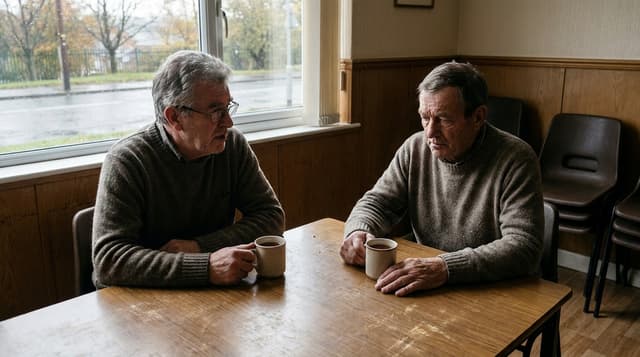
Mention the price of butter and everybody has something to say. Mention the possibility of needing long-term care and the weather becomes extraordinarily interesting.
I have noticed this several times. The conversation makes a small defensive turn. Somebody jokes. Somebody says they assume it is all taken care of. Then we discuss whether the rain is coming from the east.
The rain is easier. It rarely requires you to find a policy document.
It also gives the conversation a subject in which uncertainty feels normal. Nobody is humiliated by not knowing exactly what the weather will do. We can offer an opinion, look towards the window and remain reasonably comfortable with the possibility of being wrong.
The other uncertainty feels different. It concerns the practical arrangement of a life at a stage nobody especially wants to imagine needing help. We become less fluent, more vague, inclined to accept the first reassuring phrase available. It will be sorted out. There must be a system. Somebody will know.
Somebody may know. The useful question is who, and how I would find them before the knowledge became urgently necessary.
What worries me isn't only the cost. It is how little I know about the arrangements that might matter later. Who assesses what. Where to ask. Which assumptions I have been carrying because I've never properly tested them.
I am writing from the North East of England, not offering a guide to anyone's entitlements. Care funding and eligibility depend on where you live and individual circumstances. An account of somebody else's experience is not a reliable answer to your own situation.
That distinction ought to encourage questions. Instead, it often seems to become another reason to postpone them.
If everything depends, perhaps there is no point looking yet. If the circumstances are not known, perhaps the information cannot help. If the future is uncertain, perhaps I should wait until the uncertainty becomes something more definite.
I can hear the logic. I can also hear the avoidance travelling comfortably inside it. There may be things which cannot be settled in advance. That does not mean every question must remain unasked. Knowing where to begin could be useful even when the eventual answer will depend on details not yet available.
I don't need to obtain a complete account of every possible future before allowing myself one basic inquiry. The completeness requirement can become a very efficient way of never beginning.
The language doesn't help. Assessment. Eligibility. Provision. Words that make a serious human need sound as though it has been submitted to a procurement department.
You can reach the end of a leaflet knowing several new terms and still not knowing what would actually happen to you.
The terms may have precise purposes. I am not suggesting they were invented solely to irritate retired men. A public system needs definitions, distinctions and ways of applying them. But the reader needs a way through those distinctions which connects them to an ordinary question.
Where would I start? What would I need to know? Who can explain the part relevant to my circumstances? A person should not have to become fluent in a specialist vocabulary before being permitted to ask how help is approached.
I used to read regulations at work. I learnt that reading a great deal of paperwork doesn't necessarily mean understanding the part you will need at the awkward moment. Sometimes the useful question is the basic one you feel slightly embarrassed to ask.
Can somebody explain this in ordinary language?
That sentence is neither hostile nor unintelligent. It is a request for understanding. I know this when I am considering somebody else. When I am the person who needs the explanation, I can still feel a small reluctance to admit how little has become clear.
There is a quiet humiliation in not knowing how the system works. You feel you should already know. You have managed money, work and difficult situations for decades. Surely you ought to be able to decipher a public body's website without wanting to lie down halfway through it.
Perhaps. But the website has never commanded a ship either. We all have limitations.
The joke restores the scale. My knowledge has always had subjects and boundaries. I did not become generally informed about every administrative system simply by being trusted in a demanding role. Other people hold knowledge I may need. Asking them is a sensible use of experience, not a surrender of it.
I would like the sensible part to arrive before the embarrassment, though the embarrassment has considerable practice getting through the door first.
I want to keep the humour in the right place. There is nothing funny about dementia or the realities of needing care. The absurdity belongs to the paperwork and to the rest of us, who can conduct a detailed argument about a boiler guarantee while refusing to ask one question about our own future.
The question doesn't cause the possibility. Avoiding it doesn't remove it.
Those sentences are simple enough to sound like the entire answer. They aren't. Knowing that avoidance does not protect me has not always prevented avoidance. The emotional difficulty is less tidy than the logic.
A question can make a possibility feel nearer. A page about arrangements can turn an abstract concern into a scene I would prefer not to imagine. I may not be afraid of the information itself so much as the picture I expect to accompany it.
The picture concerns a loss of control. Having needs which do not fit comfortably into the account I give of myself. Being assessed. Waiting for an explanation from a system whose terms I barely understand. The man accustomed to managing circumstances becomes the person whose circumstances must be understood by others.
That is unsettling. It deserves acknowledgment without becoming a reason to keep every practical question at a distance.
I do not need to rehearse every difficult possibility in order to ask where appropriate guidance is available. I can seek information at a smaller scale than the fear would prefer. A point of contact. A definition. A clarification of an assumption. The inquiry need not contain the whole future at once.
The smaller scale matters because the large question can overwhelm its own useful parts. What if I need long-term care? That contains practical, financial, emotional and personal uncertainties. I cannot resolve all of them in one morning. I can perhaps identify which immediate question is unclear and ask someone appropriately placed to answer it.
The answer may lead to another question. That is not evidence that the first inquiry was pointless. It may be the beginning of understanding rather than the final reassurance I had secretly hoped to buy with one call.
I am wary of reassurance which arrives before the circumstances have been examined. A confident story about what happened to somebody else can feel comforting. It can also be irrelevant. The circumstances, location, timing and arrangements may differ in ways neither storyteller nor listener has noticed.
An anecdote can tell me that a question exists. It should not automatically become the answer to mine.
The same applies to alarming stories. A difficult experience may be real and still not predict what would happen in my situation. I can take it seriously without turning it into a complete account of the system. The story deserves its own context. My inquiry deserves information relevant to my own.
Otherwise I move between false comfort and borrowed panic, neither of which helps me understand what to do next.
This piece is not a substitute for that information. I am not setting out thresholds, promises or routes to funding. I am examining why a man who values practical preparation can become so reluctant to begin a practical inquiry when the subject touches this particular part of later life.
The reluctance is familiar enough that I suspect I am not the only person experiencing it. But suspicion is not a survey, and I do not need everybody else to share the pattern before I consider my own.
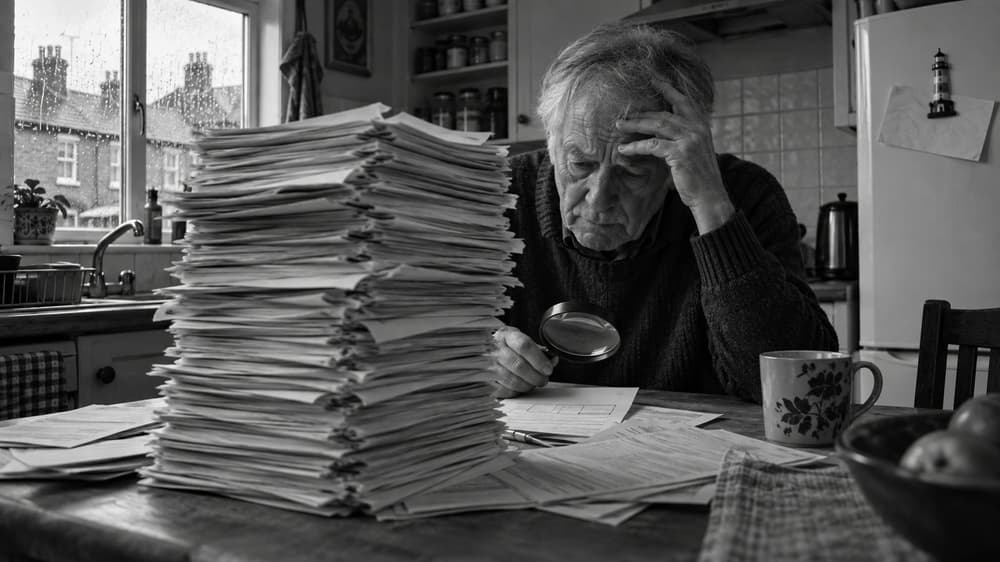
I have the question on an envelope. It has been on the fridge long enough to become part of the decoration. This is not an impressive example of taking control.
The envelope is useful in the way an uncompleted task can be useful: it shows me that the question has not disappeared simply because I stopped attending to it. It waits while the rest of the day continues. I can go out, read, write, make lunch and return to the same unanswered line.
There is nothing wrong with doing those things. Life should not be suspended until every concern has been settled. The problem is that the envelope can acquire familiarity without acquiring an answer. I stop seeing it as a question and begin seeing it as part of the fridge.
The practical matter becomes decor. A remarkable achievement in domestic avoidance.
I would like it to become a question again. Not an alarm, not a demand to imagine the worst, simply something I have identified as worth asking and have not yet asked.
Retirement has given me something useful here: time to ask before the answer is urgently needed. A morning, a notepad, the chance to seek proper local guidance and write down what has actually been said rather than relying on what I think somebody once told me.
Time does not make the subject pleasant. It creates a possibility of approaching it more calmly. I can pause, read a little, ask for clarification and return to something unclear without trying to fit the inquiry between departure times and another person's urgent problem.
That is a genuine benefit of the stage I am in. I do not want the subject's difficulty to conceal it. There is room for practical attention which I often did not have before.
I can also leave the inquiry after it has served its useful purpose for the day. Asking does not oblige me to spend every remaining hour thinking about needing care. A practical concern can receive a place without being allowed to occupy the whole house.
This distinction matters. I may avoid beginning because I fear I will not be able to stop imagining once the question is open. The concern becomes a room with no exit. Better to leave the door shut and discuss the forecast.
A more manageable arrangement would give the inquiry boundaries. The particular question, an appropriate source, a note of what I understand and what remains unclear. Then return to the current day. The return is not denial. It recognises that present life still deserves living while future possibilities receive sensible attention.
I don't offer that as a professional method. It is the sort of modest arrangement I might need in order not to turn one question into an indefinite afternoon of worrying. Others may find different approaches more useful, and some will need direct help with circumstances far more immediate than mine.
The scale of this account is one man noticing his own avoidance. It should not be mistaken for a judgment on how anybody else has prepared.
There are reasons an inquiry may be difficult beyond reluctance. Information can be confusing. Contacting a service can take effort. The situation may involve questions which require qualified advice rather than a general explanation. A person may have limited time, energy or ability to pursue the matter unaided.
Those difficulties deserve support, not a lecture about being proactive. I would be disappointed if the piece became another instruction telling people to take control of a system they do not control.
I can choose to ask. I cannot guarantee how clear the answer will be or how straightforward the eventual arrangements might become. Preparation can improve understanding without producing mastery over every condition.
That limitation is worth accepting at the beginning. Otherwise I may demand certainty from the inquiry, fail to obtain it and decide the effort was useless. The more plausible aim is to know a little more accurately where to turn and which assumptions should not be relied on.
Accuracy is a quieter benefit than reassurance. It may include uncomfortable facts. It may also remove an unnecessary fear. Either can be useful if the information is appropriate and understood correctly.
The important thing is not that the answer feels soothing. It is that I know what question it answers and what it does not.
I learned that distinction at work. A document could look authoritative and still concern a situation different from the one in front of me. A broad rule required careful reading. An explanation could be correct in general and incomplete for a particular decision.
Experience ought to make me respectful of those limits here, not embarrassed by needing help with them. I don't know the system. I can admit that plainly and seek an explanation from someone whose role includes knowing it.
The admission is practical. It saves me trying to produce confidence from repeated reading which has not yet produced understanding.
There is also a difference between an official description and my interpretation of it. I can read a sentence, assume I recognise the meaning and carry that assumption away as knowledge. If a key word matters, it may deserve asking about rather than being silently translated into what I hoped it meant.
A note can preserve the wording. It cannot, by itself, preserve an understanding I have not obtained. I would like to write down not merely the phrase but the explanation, in language I can later recognise without reopening the same confusion.
If I still cannot explain it to myself, perhaps I need another question rather than more confidence.
The basic question remains respectable. Who would I contact to understand arrangements relevant to where I live? What information would make the inquiry useful? Which part requires specialist guidance? I can begin there without pretending I already know the answers.
The wording can remain ordinary. I do not need to borrow a more impressive vocabulary to sound deserving of an explanation. The person listening may find a clear question easier to address than a hesitant performance of partial knowledge.
That is something I know from being on the other side of questions. A person who says what they do not understand gives me something to help with. A person who tries to conceal the gap can leave both of us discussing different things without noticing.
I can offer the same clarity when the gap is mine.
The future remains uncertain after the question. That is not a fault in asking. I am not trying to predict every need, every expense or every choice. I am trying to avoid discovering at a difficult moment that a reassuring belief was never checked.
There is a considerable difference between planning for a possibility and believing I can plan the possibility away. The first may be useful. The second is a promise no envelope should be asked to carry.
I would like to keep the first and be suspicious of the second. Otherwise preparation becomes another route towards disappointment when life refuses to follow the complete arrangement I imagined.
The conversation about the weather has another advantage: it allows everyone to remain independent in the familiar sense. We look outside, offer a view and have no need to imagine being assessed or assisted. The subject keeps us in the position of observers rather than possible recipients of help.
Care changes that position in imagination before anything has changed in practice. It asks us to consider circumstances in which the ordinary tasks might require more support. That can touch a sensitivity older than the immediate question, the wish to remain the person who manages rather than the person whose management needs attention.
I recognise the sensitivity. I have spent much of life valuing capability. Decisions made, difficulties handled, responsibilities accepted. I do not want the experience to be reduced to a story about needing assistance simply because the topic has appeared.
But assistance and capability are not absolute opposites. A person can remain capable in many ways while needing help in a particular one. A person can have preferences, judgment and a history while receiving care. The need does not become the whole person merely because it is significant.
That is important to say without claiming to know what every experience of care feels like. I don't. I cannot speak on behalf of people whose circumstances are different from the possibility I am considering. I can examine the narrow assumption which makes the topic harder for me to approach: that needing help would erase the rest of me.
The assumption is too broad. It adds an unnecessary fear to questions which are already serious enough.
I can want to preserve choices without imagining that independence means never relying on anybody. My current life already relies on other people's work. The roads, services, shops, buildings and information which make an ordinary day possible were not supplied by my personal competence.
The reliance is usually unobtrusive. Care might make a particular form of it more visible, more personal and more difficult. Those differences matter. But visibility is not the moment at which dependence first enters the human arrangement.
I have been supported in ways I take for granted. I have supported others through work and ordinary acts. Help is not a foreign substance introduced into an otherwise self-sufficient life.
This does not make the practical questions vanish. Who provides what? How are needs understood? What choices could be available? What would I need to know about the process? Those remain appropriate questions for qualified, relevant sources, not assumptions drawn from a reassuring philosophy about interdependence.
The philosophy may make asking less humiliating. It does not answer the inquiry.
I would like to keep those jobs separate. Emotional reassurance has a place. Practical information has a place. Neither should impersonate the other merely because I would prefer one combined answer which settles everything before the kettle boils.
The kettle can boil without settling the question. It has done so many times already. The envelope continues to look unusually at home beside it.
There is no need for every discussion of later life to begin with catastrophe. I have noticed how easily the subject becomes dramatic: a frightening story, an enormous hypothetical bill, an account of a system delivered with the confidence of someone who has read one angry comment.
Fear can grab attention. It can also make the useful question harder to ask because the whole subject feels like a warning whose only sensible response is alarm. I would rather begin with what I do not know and identify the appropriate place to find out.
That is less exciting. It may be more helpful.
Some questions will still be uncomfortable. The answers may involve limits, conditions or choices I do not especially like. I should not demand that proper guidance protect me from every unpleasant fact. Its purpose is to help me understand, not to preserve my preferred impression of the future.
But understanding can reduce the confusion which makes an uncomfortable subject feel even larger. A clear explanation of one point may let me stop imagining several incompatible possibilities at once. A reliable contact may make the next question less remote.
The benefit need not be complete certainty. A little less unsupported assumption can be worth obtaining.
I am wary of declaring that everybody should have done this already. The topic is complicated, and lives contain demands which are not visible from the outside. Someone may have tried to ask and received little clarity. Someone may be managing circumstances in which a spare morning is not available. Someone may need help approaching the inquiry itself.
My own delay should not become a moral standard applied to strangers. The useful admission is personal: I have some time, I have identified a gap and I have allowed the gap to remain partly because the subject unsettles me.
That gives me something to consider now. It does not entitle me to assess anybody else's preparation.
There are also assumptions which come from familiar language rather than deliberate beliefs. Taken care of. Covered. Provided. Each can sound complete while concealing uncertainty about who, what, when and under which circumstances. I can repeat the phrase without noticing how much information it leaves out.
The phrase may be correct in a particular context. It may be incomplete. I need to know the context before using it as reassurance. A comforting sentence which cannot answer a basic follow-up question is perhaps a place to begin an inquiry, not a place to end one.
I can ask what the words mean without arguing with the person who used them. The aim is not to expose ignorance at a table. It is to notice that a shared assumption may not have been checked by anybody present.
A conversation can become more honest if someone simply says they are not sure. Not as a theatrical confession, just a practical qualification. I don't know how that works here. I would like to find out. That opens more useful room than confident repetition of something heard years earlier.
The weather can remain available afterwards. It is patient in that respect. We are not obliged to abandon all pleasant conversation because one serious question has entered the room.
That is another false choice I sometimes make: either leave the topic alone or turn the entire occasion solemn. There is a middle register in which adults discuss a practical uncertainty calmly and then continue with the day. The discussion need not become an announcement that the future has arrived at the table.
A question is an inquiry, not a diagnosis. It can concern a possibility without establishing that the possibility is imminent.
I would like that distinction to become easier to feel. At present I can know it and still notice my mind taking a small step towards the forecast when the care question becomes specific.
The step is not dramatic. It is a little rearrangement of attention. Perhaps I should check the rain before going out. Perhaps there is another task worth doing first. The practical matter moves quietly behind something more immediately manageable.
The manageable thing may genuinely need doing. That makes the avoidance harder to identify. I cannot simply label every errand an excuse. But I can notice the sequence: the difficult question appears, an easier one acquires urgency, and the envelope remains on the fridge another day.
That pattern is information. It suggests the obstacle is not only a shortage of time.
I can respond to the pattern at the same small scale. Name the particular question. Decide what sort of help could answer it. Give it a place in the current week rather than letting it become indefinitely available to a better-organised future version of me.
The future version has been assigned many tasks already. He is expected to be calm, informed and willing to read material which the present man finds confusing. I am not sure where he will obtain those qualities if I keep withholding the opportunities through which they might develop.
Perhaps the present man can begin uncertainly and acquire a little clarity. That is how learning generally happens. It would be unreasonable to require complete confidence before asking the question whose answer might provide some.
I don't need to become an expert. I need to know enough to recognise what remains outside my knowledge and where appropriate guidance is needed. Expertise belongs to the people qualified to provide it. My role is to make the inquiry intelligible and avoid treating a general remark as a personal determination.
The boundary is protective rather than disappointing. It prevents me converting a short essay, a conversation or an account from another place into advice it was not equipped to give.
There may be legal, financial or care-specific issues which require qualified local advice. I would rather be told that plainly than receive an easy answer from somebody whose confidence exceeds their knowledge. The ease might be comforting today and unhelpful at the point when accuracy matters.
I can accept a referral to the right expertise as progress, even when it leaves the immediate question partly open. Knowing who should answer is itself a useful distinction.
The notepad can help me keep those distinctions visible. What I have been told, by whom, in relation to which question. What I understand. What needs clarification. I can preserve the limits alongside the answer instead of allowing the remembered reassurance to become broader each time I repeat it to myself.
Again, this is not a professional checklist. It is a modest habit of attention from a man who has read enough paperwork to know that memory can compress an explanation in ways the explanation never authorised.
Compression is convenient until the omitted condition turns out to matter.
There is an emotional benefit in having the question somewhere other than the back of my mind. A written line can make it smaller. Not less serious, just more specific. The vague concern has been able to expand because I have not decided what part I am actually trying to understand.
A specific question may still be difficult. It is less able to pretend it contains every possible future at once.
The envelope had done part of that work already. It held a question. I had stopped noticing the question because the object became familiar. I can restore its function without creating a dramatic ceremony around taking control.
Taking control is a phrase I distrust here. I can take responsibility for an inquiry. I can seek understanding. I cannot control every future need or every feature of the arrangements I might encounter. The phrase promises more than the act can deliver and may make a modest act feel insufficient.
I would rather value what the act can do. One assumption checked. One point understood. One appropriate source identified. These are not guarantees. They are useful changes in what I know.
The current day can then continue. A walk, a book, lunch, something I want to write. Those pleasures do not become less legitimate because I have considered a serious possibility. Nor does considering the possibility betray the wish to enjoy the life I have now.
The two forms of attention can support one another. Practical understanding may remove a little background uncertainty. Enjoying the day may prevent the inquiry becoming the whole account of later life. Neither needs to defeat the other.
That seems a more comfortable arrangement than alternating between avoidance and alarm.
I am not there reliably. The envelope is still present. The mind still has a well-practised route towards the weather. I have not made the call and returned with an organised folder which I can offer as proof of transformation.
I want to leave the account honest at that point. Recognition is not completion. A question named is not a question answered. I can write about the avoidance and still have to decide what happens to the envelope when I finish writing.
There is a small danger in the writing itself. It can feel like dealing with the subject because I have dealt with the feeling around it. The prose becomes another practical-looking act which leaves the practical inquiry untouched.
I would like to notice that danger too, without making every useful thought sound fraudulent. Writing can help me understand the reluctance. It simply cannot substitute for guidance about the arrangements.
The next act belongs outside the page. That is inconvenient for a man who is rather comfortable on the page, but convenience is not the measure of whether the question deserves asking.
I don't expect the inquiry to make me enthusiastic about the subject. Calm is a modest hope. Enough understanding to know what I should not assume, enough confidence to ask when something remains unclear, enough perspective to return to the ordinary day without pretending the possibility has been abolished.
The hope does not require a cheerful ending. Some questions remain serious after they are asked. Some answers are provisional. The world can be more complicated than the phrase with which a conversation began. I would rather know that than discover too late that the phrase had been carrying information nobody actually possessed.
There is dignity in asking before dignity has been made unnecessarily dependent on pretending to know. I have managed difficult things by understanding the limits of my knowledge, not by denying that limits existed. This subject deserves the same approach, with its own appropriate sources and its own boundaries.
I can bring the experience of being careful without claiming expertise I don't have. I can ask a simple question without becoming a simple person. I can take the possibility seriously without letting it replace every other part of the life I am living.
Those distinctions are small enough to practise. They will not organise a whole system or guarantee a future arrangement. They may make the envelope less decorative and the next useful question easier to recognise.
The forecast will remain available after the inquiry. So will the kettle, the book and the freedom to go out when the weather improves. I need not choose between understanding a practical concern and enjoying those freedoms. The concern can receive attention because the life matters, not instead of the life.
That is what I would like to remember when my mind makes its turn. The other question is not an unwelcome visitor which has arrived to spoil retirement. It is a gap in my understanding. I can give the gap some attention without granting it the whole afternoon, then come back to the tea while it is still warm.
Still, I notice the envelope now when I put the kettle on. I can hear the little manoeuvre my mind makes towards the forecast.
It may rain tomorrow. That information is available everywhere.
The other question is the one only I can decide to ask.
Before you wander back into the ordinary noise of the day, do one small thing with this.
Not a grand reinvention. Not a ten-year vision board. Just a quiet refusal to drift.
Because later life has a habit of becoming whatever is left after everyone else has had their say: the pension provider, the calendar, the family WhatsApp, the old job still living rent-free in your head.
The danger is not that you fail to make a plan.
The danger is that you inherit one by default.
If this piece nudged something uncomfortable but useful, I’d start here:
The Second Act Playbook is for building the shape of the next chapter before life fills it in for you.
The Retirement Identity Check-In is for the quieter question underneath it all: who are you becoming when the old labels loosen?
One is Free the other isn’t I will leave it to you to have a look. Neither is about panic.
They are about not waking up five years from now with a tidy pension and a life that somehow forgot to include you.